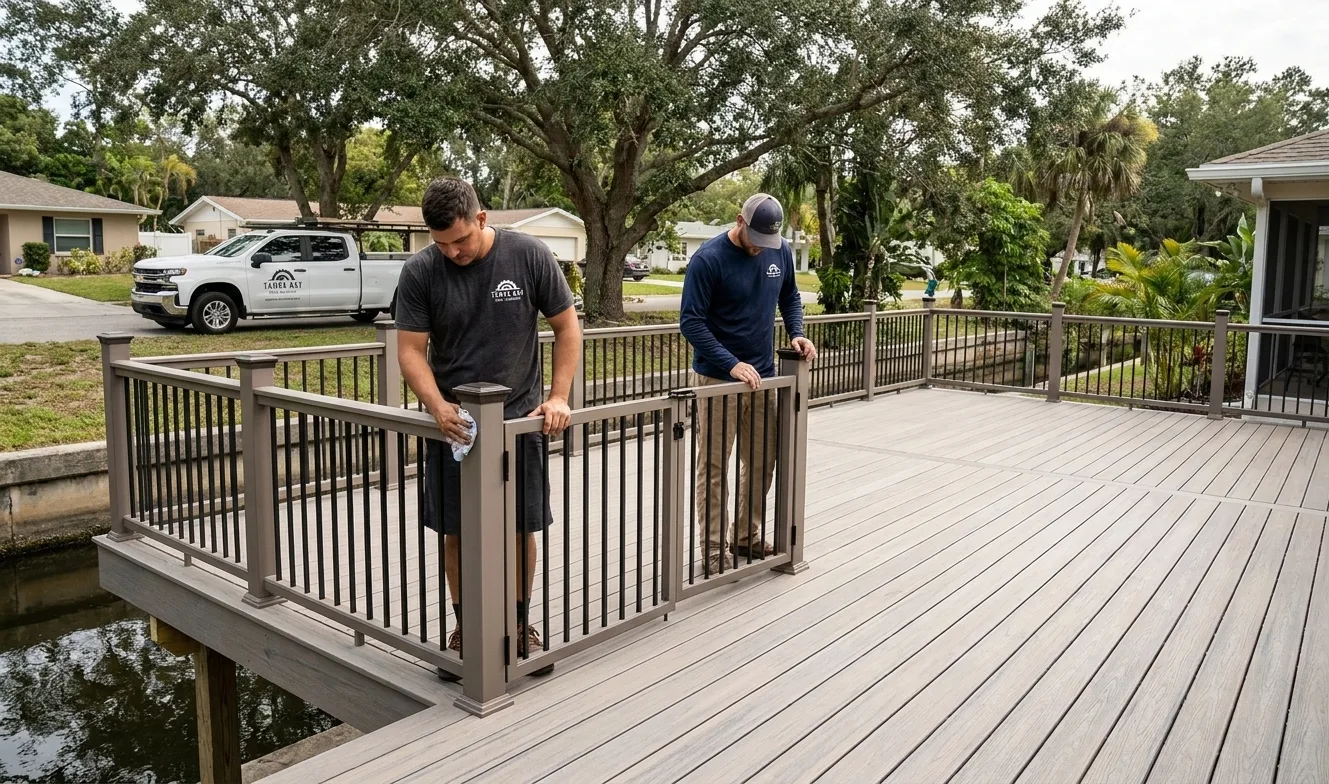
Wood vs. Composite: Side-by-Side for Florida
| Factor | Pressure-Treated Wood | Composite / Trex |
|---|---|---|
| Upfront cost (installed) | $35 – $45 / sq ft | $60 – $85 / sq ft |
| Maintenance | Stain/seal every 1–2 years | Occasional soap-and-water wash |
| 20-year cost of ownership | Often higher (labor + product) | Often lower over the long run |
| Heat & UV performance | Grays/cracks without upkeep | Fade-resistant capped boards hold color |
| Humidity/rot resistance | Good if sealed consistently | Excellent, won't rot or absorb water |
| Typical lifespan | 12 – 20 years with upkeep | 25 – 30+ years |
Upfront Cost vs. Lifetime Cost
Pressure-treated pine wins on day one — it's roughly 40 to 60% cheaper to install than composite. But that gap narrows fast once you factor in what Florida's climate demands. Wood in our market needs staining and sealing every 1 to 2 years to prevent cracking, graying, and rot, at $2 to $4 per square foot each time. Run that math over 15 or 20 years and the total cost of ownership for wood often catches up to, or exceeds, composite — without even accounting for eventual board replacement.
Maintenance: The Real Difference-Maker
This is where most Tampa Bay homeowners make their decision. Wood decking in our humidity and rain needs a consistent sealing schedule — skip a year or two and you'll see graying, splintering, and soft spots start to creep in, especially on boards that get direct afternoon sun. Composite decking needs essentially none of that. An occasional wash with soap and water handles mildew or pollen buildup, and there's no staining, sanding, or sealing ever required. If you don't want a recurring outdoor chore on your calendar, composite is the clear winner.
Heat and UV Performance
Both materials face the same brutal Tampa Bay sun, but they age differently. Untreated or under-maintained wood grays and can develop surface checking (small cracks) within a couple of seasons. Quality capped composite, like Trex Transcend and Enhance, is engineered specifically to resist UV fading and holds its color for decades. On barefoot comfort, lighter colors in either material stay cooler — dark composite and dark hardwood both get noticeably hot in direct Florida sun, so color selection matters as much as material choice if bare feet will be on it often.
Resale Value in the Tampa Bay Market
Composite decks tend to command a slightly stronger resale premium in our market because buyers recognize they're inheriting a low-maintenance feature rather than a recurring project. That said, a well-maintained, professionally built wood deck still adds real value — the bigger risk with wood is a poorly maintained deck actively hurting a sale, since visible rot or damaged boards read as deferred maintenance to buyers and inspectors.
Which Should You Choose?
If your budget is tight and you're comfortable with a sealing routine every year or two, quality pressure-treated pine is a perfectly good choice that we build to last. If you want to spend more once and essentially forget about maintenance for two to three decades — especially on a canal-front or pool-adjacent deck that sees heavy sun and moisture exposure — composite is worth the premium.
PAA: Wood vs. Composite Decking Questions
Is composite decking worth the extra cost in Florida?
For most Tampa Bay homeowners, yes. The maintenance savings alone typically close the cost gap within 6 to 8 years, and composite outlasts wood by a decade or more in our humidity.
Does wood decking rot faster in Florida than other states?
Yes. Florida's humidity, UV intensity, and hurricane-season rainfall accelerate wood decay compared to drier climates, which is why we recommend sealing every 1 to 2 years here versus every 2 to 3 years elsewhere.
Let Us Help You Decide
Every free estimate includes an honest recommendation based on your budget, how the deck will be used, and how much sun exposure the space gets — not just whichever material has the best margin for us. Get your free estimate or call (813) 536-3984 to talk through both options for your yard.
Also see: How Much Does It Cost to Build a Deck in Florida? and Best Decking Material for Pool Areas